

Today, we present an Intrepot review, where we take a closer look at a Forex/CFD broker that promises a clear and transparent approach to trading. Clients are offered a wide choice of account types with discounts on spreads and swaps, zero-commission trading, a broad range of assets, and professional support. At the same time, the company operates under an official license. Need more reasons to start trading here? However, we were not so easily convinced, so we decided to find out whether we were dealing with yet another scam project. In the following sections, we share the results of our research.
Contents
- Key Points to Know
- What Stands Out About the Intrepot.com Website
- Inside the Offshore Registration of Intrepot
- Trading Conditions Explained
- Checking Compliance with Legitimate Rules
- How Long Has Intrepot Been Around?
- Platform and Support Overview
- Online Reputation: What We Found
- Conclusion: Risks and Reliability of Intrepot
- Sources
Key Points to Know
| Main Website | https://www.intrepot.com/ |
| Additional Domains | Not Found |
| Online Since | 2024/12/30 |
| Legal Entity Name | Intrepot Investments Ltd |
| Pretended to Be Regulated | MISA (Mwali, Comoros Union) |
| Fact-Checked Regulation | MISA (Mwali, Comoros Union) |
| Deposit to Start Trade | $250 |
| Leverage up To | 1:200 |
| Spreads From | Unknown |
What Stands Out About the Intrepot.com Website
-
The company's registration in the Comoros Union and the existence of its license have been documented.
-
The minimum amount required to start trading is $250, which is relatively small for most traders.
-
The broker is registered and licensed offshore. The regulatory document does not provide the level of client protection that would normally be expected and is not recognized by major regulators and industry experts.
-
Trading conditions are almost completely hidden, making it difficult to assess the level of risks and costs traders may face.
-
The terms and conditions for non-trading operations are also not published.
-
It is impossible to complete the registration process without contacting customer support.
-
There are currently no customer reviews available online.
Inside the Offshore Registration of Intrepot
The broker states on its website that it is registered on the autonomous island of Mwali (Moheli) and holds a license issued by the local financial regulator, the Mwali International Services Authority (MISA). Such offshore documents are often used primarily as formal proof that a company is legally operating. For a client, the presence of the word “license” and a license number may look convincing, but this says little about the quality of regulation, the extent of oversight, or the availability of investor protection mechanisms.
This applies fully to MISA licenses. First of all, the main financial regulator of the Comoros, the Banque Centrale des Comores (BCC), has periodically published official press releases (BCC statement on illegal offshore banking activities) concerning what it describes as illegal financial activities involving local regulators.
Therefore, the existence of a document issued by MISA should not be interpreted as proof of full-fledged financial regulation. Moreover, the BCC’s position has also been echoed by the IMF, the World Bank, and the FATF. For a potential client, this is an important consideration: it is not enough to look at whether a license exists; it is also necessary to determine who issued it, whether that organization has the legal authority to do so, and what mechanisms are in place to supervise trading platforms.
The MISA license is not the only issue that may raise concerns; the local corporate registration itself can also be problematic. Companies operating from this jurisdiction may face increased scrutiny from bank compliance departments. Major international banks may automatically classify them as “High Risk,” and in some cases even as “Unacceptable Risk.”
For businesses, this can create significant practical limitations. Banks and payment institutions in the EU, US, UK, UAE, and Singapore may refuse to open accounts for companies from this jurisdiction or require extensive additional due diligence before doing so. Correspondent banks may also suspend, block, or freeze international transfers involving companies from Mwali. Similar difficulties can arise with major payment services such as Stripe, PayPal, and Adyen, which may not provide services to customers they consider high-risk or otherwise unsuitable.
Why, then, do brokers continue to use licenses of this kind? The reason is fairly obvious: for many projects operating online today, such a document can be more useful as a marketing tool than a license issued by a reputable regulator.
- Most retail traders simply will not take the time to investigate what MISA actually is, what powers it has, or whether its documents are recognized internationally. For many users, simply seeing the phrase “regulated broker” is enough to replace skepticism with a sense of security.
- Another obvious advantage for the owners of such projects is the simplicity, speed, and low cost of the procedure. MISA can be particularly attractive to small companies and startups that do not want to go through the complex and expensive licensing process required by a reputable regulator. Company registration combined with licensing in this jurisdiction reportedly costs around €6,500 and can be completed within 1–2 days.
- Brokers are not required to maintain significant capital reserves or deposit the corresponding amount in a bank account. As a result, the financial threshold for launching a brokerage business is substantially lower than in jurisdictions with comprehensive financial regulation. For clients, however, this also means the absence of an additional reliability filter.
- The regulator does not require client funds to be held in segregated accounts, participation in deposit compensation schemes, or the presence of a physical office in the country. Trading conditions are also not subject to many of the restrictions typically imposed on brokers holding licenses from well-established regulators.
For project owners, this can therefore look like an almost ideal model: minimal costs, limited bureaucracy, and considerable freedom to organize the business according to their own rules. For clients, however, the picture is quite different. The fewer mandatory requirements imposed on a broker, the fewer external safeguards are available to the trader.
Interestingly, this situation can be psychologically more dangerous for users than completely unregulated activity. The absence of a license at least makes it clear that the company is not subject to the relevant regulatory oversight. An offshore document, on the other hand, can create a sense of protection for an inexperienced client that may not reflect the actual level of protection available.
Trading Conditions Explained
Like many offshore platforms, the broker does not appear eager to disclose its trading conditions to potential clients in advance. So, what exactly does a trader get when planning to trade with Intrepot?
Naturally, the first place to look is the Instruments page, where one would expect to find a complete list of markets, available trading assets, and, ideally, contract specifications. However, the content of the page is of very limited use for this purpose. Instead of detailed descriptions and tables outlining the characteristics of trades, there are only one or two sentences describing each asset category. We could hardly consider these brief fragments sufficient trading information.
We did manage to find some information about the trading conditions in the descriptions of the available account types. The platform offers three plans: Silver, Gold, and Platinum. All three options share several basic parameters:
- Leverage of up to 1:200.
- Minimum trade volume of 0.01 lots.
- Stop-out level of 5%.
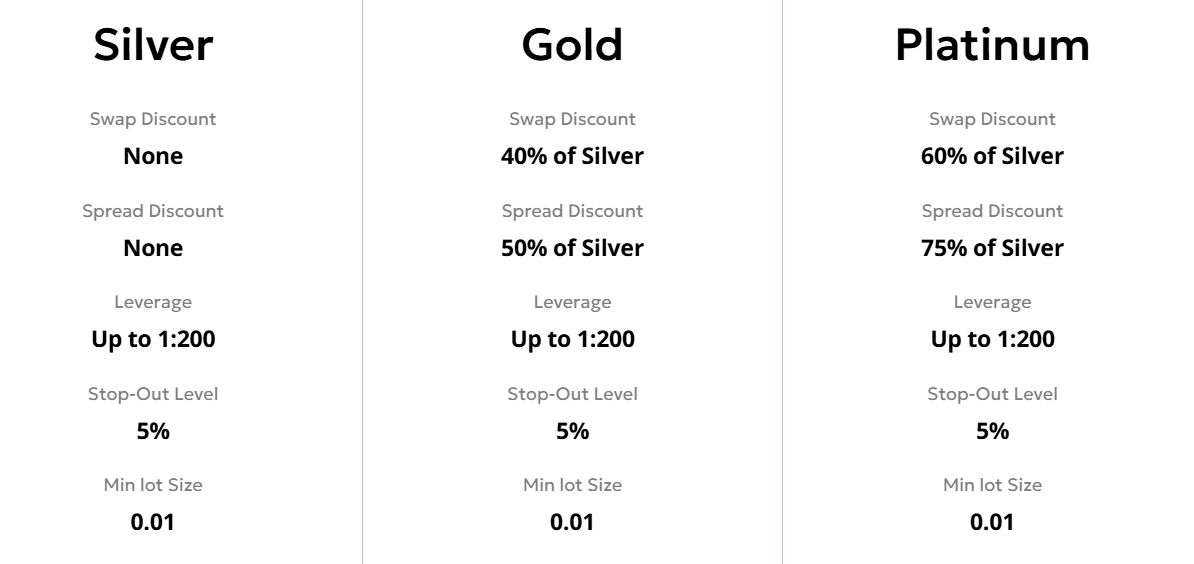
Let’s start with leverage. The maximum level of 1:200 looks quite high for retail trading. For comparison, retail clients in the UK, EU countries, and Australia have access to significantly lower leverage levels. For major currency instruments, the standard limit is around 1:30. Higher leverage is generally available only to traders with professional status, which can be obtained only after meeting certain, often fairly demanding, requirements.
This is where it is worth remembering the well-known statistics on retail CFD trading: a very large number of individual clients lose money during their first months of trading. European regulators have reported figures exceeding 80%. And this is despite the existing restrictions on maximum leverage of 1:30. Against this background, offering leverage of 1:200 appears particularly risky for inexperienced users. For a professional trader who understands and properly applies risk-management rules, the risks may be considerably lower. However:
- How many beginners have even heard of such rules, are willing to study them, and are prepared to apply them?
- Where does Intrepot distinguish between different categories of traders?
Of course, the regulator under which the platform operates does not require such a classification (and may not even have such a framework). However, this does not mean that the broker is not exposing its clients to additional risk. The only question that remains is whether this is being done deliberately.
In our view, this appears to be a calculated business decision. The possibility of making large profits quickly can be an effective argument for attracting new clients, while few users are likely to read a document such as the Risk Disclosure Policy. If traders lose their funds quickly, this may benefit Intrepot, since the broker acts as the counterparty to their trades. In such a situation, clients’ losses can become the company’s gains.
Another parameter that cannot be ignored is the Stop-Out level. The platform lists it at just 5%. In simple terms, this means that positions are forcibly closed when the account equity falls to 5% or less of the initial margin required for the position.
In practice, after forced liquidation, a trader may be left with such a small balance that continuing to trade requires another deposit. We believe that the broker deliberately sets the Stop-Out level this low to encourage additional deposits. There is a direct connection here: the longer a position remains open while the market moves against the trader, and the lower the forced-liquidation threshold, the more capital the client can lose before the Stop-Out is triggered. After that, in many cases, the only way to continue trading is to deposit additional funds.
Let’s also briefly discuss the differences between the account plans. They mainly concern spreads and swaps. For the Gold account, these figures are supposedly 50% and 40% lower than those offered under Silver, respectively. The Platinum account promises even larger discounts: 75% on spreads and 60% on swaps. The figures certainly look impressive. But this raises a fundamental question: what original values are these discounts actually calculated against?
This is why an experienced trader evaluates not the size of the advertised discount, but the final cost of trading. It is important to know the spread, commission, swap conditions, and other fees that directly affect the trading result. The absence of the original figures is particularly noticeable here. If a broker offers discounts of this scale, it would be reasonable to show clients the initial values so they can independently assess how attractive the offer actually is. Otherwise, the discount percentages are little more than a marketing tool. We cannot rule out the possibility that even after the discounts are applied, the final trading costs may remain excessively high.
Thus, the information published by the broker is insufficient to consider its trading offer genuinely transparent. We are shown individual figures, but not given a complete picture of the costs and risks. This alone does not prove that the broker intends to act exclusively against its clients. However, for a trader, it is a clear signal that the information provided by Intrepot should be approached carefully and with extreme caution.
Checking Compliance with Legitimate Rules
As we have already mentioned, the project owners state that the company is registered in the Comoros Union on the autonomous island of Mwali (Moheli) and holds a license issued by the local financial regulator, MISA. Essentially, this document is the only legal basis cited for the company’s provision of brokerage services. Naturally, we checked the information provided by the broker.
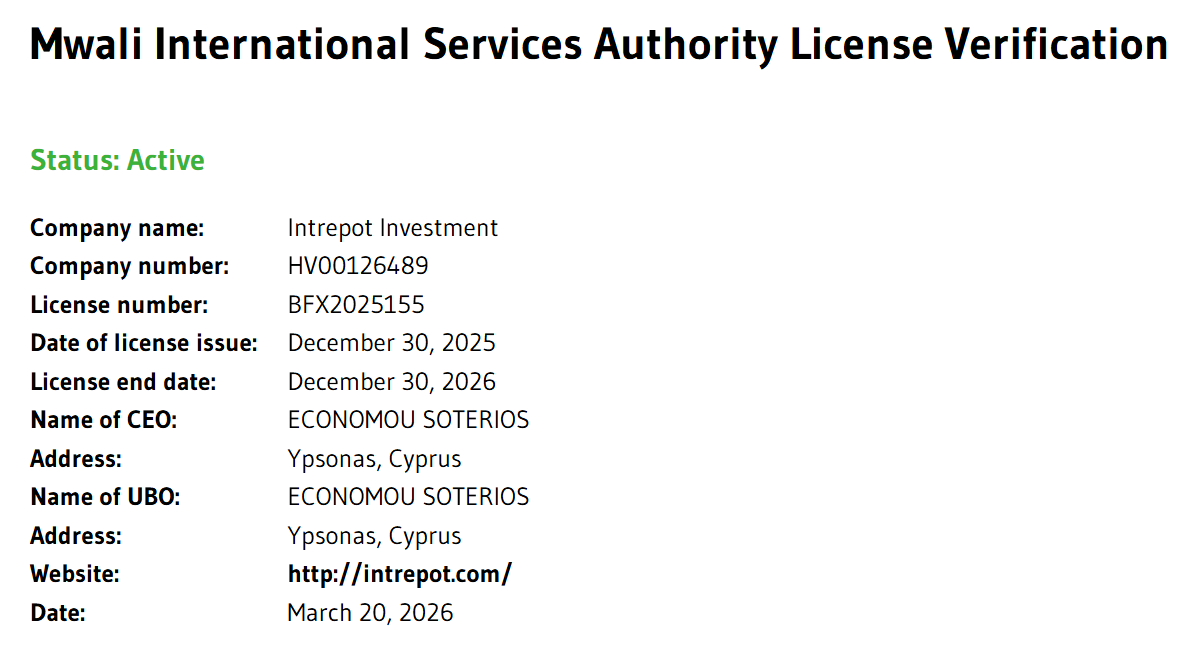
As we can see, the information was fully confirmed: Intrepot Investment is registered under No. HV00126489 and received brokerage license No. BFX2025155 on December 30, 2025. The regulator’s database also states that the company operates through the website intrepot.com.
Thus, we established that the Intrepot broker does in fact legally exist and operates under an offshore license. We have already discussed above the question of how much trust should be placed in this document, so we will not repeat those arguments here.
There is another fact worth mentioning. There is a broker called CIFMarkets operating online, registered and licensed in South Africa. In its documents, including its Terms & Conditions, the company states that it is neither a dealer nor a market maker and only provides its clients with access to instruments offered by Intrepot, with a reference to intrepot.com.
There is, however, one issue: CIFMarkets has existed since 2022, at least according to the date stated in its documents, whereas, as we established, Intrepot obtained its license only at the end of December 2025.
The explanation suggested by the original analysis is that this may be connected with tighter regulatory requirements in South Africa. According to that account, brokers needed either an additional Over-the-Counter Derivative Provider (ODP) license or evidence that the local FSP was not the sole counterparty to clients’ trades. The analysis therefore suggests that an offshore brokerage structure was subsequently established, where such requirements did not apply in the same way.
How Long Has Intrepot Been Around?
We believe it is clear that the history of an online platform should not be counted from the moment it obtains a license, but from the date when it actually begins operating online. The broker itself does not disclose this information, so the actual length of its operation can only be determined using independent public sources.
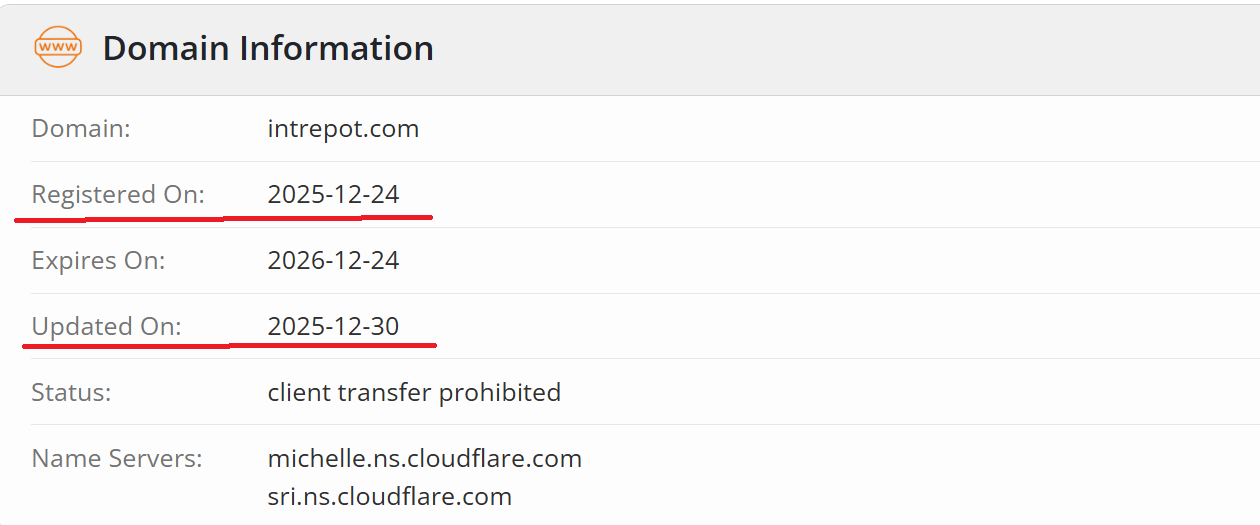
We obtained the domain registration details through a WHOIS service. As we can see, they are almost identical to the company’s official information: the domain discussed in our review was registered on December 24, 2025, while the date of the latest significant update — December 30 — exactly matches the date when the license was issued. According to the original analysis, this is clear evidence of how quickly the alleged operators created a story around the provision of trading services for another project of theirs.
In reality, we can say that this broker had not even begun its core business activity at that point. Online, it was known not as a trading platform, but primarily as an offshore product provider and trading counterparty for CIFMarkets. The lack of a fully established operational presence, which we mentioned earlier, also points in this direction.
Platform and Support Overview
We can assess Intrepot’s trading platform only based on the broker’s own statements, since access to the software is also unavailable without opening an account.
The company claims to use a modern terminal based on TradingView technology and highlights the following advantages:
- Instant order execution.
- An intuitive interface.
- Professional market-analysis tools.
- Flexible customization.
- Full security of user data.
Of course, there is no evidence provided to substantiate these claims. However, judging by the screenshots on the Platforms page, the software appears to be the same platform used by CIFMarkets.
We are familiar with this software because several brokers that have previously come to our attention use it as well. Therefore, we can easily identify some of its main limitations:
- There is no full-featured multi-chart mode.
- One-click position opening is not available.
- Interface customization is limited: traders cannot change the arrangement of windows, apart from closing them or adjusting their size.
- Automation tools, such as connecting external modules or using an API, are not available, nor is the ability to add custom indicators.
The contact information is no better. The website creators have prepared a Support Hub page containing several questions and answers covering many common user issues. However, they do not allow clients to completely avoid direct communication with support.
This is where Intrepot has problems. The Contact Us page contains a feedback form, and this is effectively where the communication options offered to clients end. We did manage to find an email address in the platform’s documentation, specifically in its Privacy Policy. It remains unclear whether a new trader would be able to find it easily.
There are also no links to social-media profiles. For a modern online project, this looks questionable. Given the shortcomings in the website’s content already mentioned above, the absence of an active social-media presence is perhaps unsurprising.
Online Reputation: What We Found
The situation regarding the broker’s visibility online is telling: we were unable to find a single intrepot.com review. This further confirms that, if the company has indeed started working with retail clients, it did so only very recently. Before that, according to our analysis, it was used as a front for the CIFMarkets scam project. Naturally, there is no established reputation to speak of.
Conclusion: Risks and Reliability of Intrepot
Ultimately, in our review, we have collected enough evidence to conclude that traders should not do business with this broker. Yes, Intrepot operates under an MISA license, but this license does not inspire confidence. At the same time, the company does not disclose its trading conditions, uses a far-from-ideal trading terminal, provides no information about non-trading operations, and does not even allow potential clients to complete the registration process independently. All that remains is to consider the platform’s complete lack of visibility online and ask ourselves: something is clearly not right here.
Sources
BCC press release about MISA & AOFA



27.09.2026 at 02:04
Intrepot is a scam!
I transferred $5,000 to the account because they had both company registration and a license. It took a long time to persuade them to register me, though. But when I was told that I would actually be trading through CIF Markets, and the platform there was simply terrible and all my trades started going into the red, I became concerned and contacted support for help. I wish I hadn’t. The manager told me that I needed to add more capital to support the position and then advised me to open another one. That position also went deep into the red and wiped out almost my entire deposit. Do you think I managed to withdraw what was left? No. And after that, support stopped responding to me on both platforms!