

Today, we present our Airmarkets review — an in-depth look at a platform that claims to offer users the optimal balance in trading. This Forex/CFD broker promises to provide traders with state-of-the-art tools, flexible conditions for effective trading, and personalized solutions for CFD trading. However, behind these grand claims lies nothing more than a set of generic promises unsupported by real evidence or concrete action. Want to know whether this company can be trusted, or whether its clients are facing yet another scam project and the bitter disappointment of losing their funds for good? Find the answers in our analysis below.
Contents
- Key Points to Know
- What Stands Out About the Air-markets.com Website
- Inside the Offshore Registration of Airmarkets
- Trading Conditions Explained
- Checking Compliance with Legitimate Rules
- How Long Has Airmarkets Been Around?
- Platform and Support Overview
- Online Reputation: What We Found
- Conclusion: Risks and Reliability of Airmarkets
- Sources
Key Points to Know
| Main Website | https://www.air-markets.com/ |
| Additional Domains | Not Found |
| Online Since | 2026/02/02 |
| Legal Entity Name | Airmarkets Comoros Ltd |
| Pretended to Be Regulated | MISA, Mwali (Moheli), Comoros Union |
| Fact-Checked Regulation | MISA |
| Deposit to Start Trade | €250 |
| Leverage up To | 1:200 |
| Spreads From | Unknown |
What Stands Out About the Air-markets.com Website
-
The operating company is officially registered and holds a MISA license.
-
The minimum deposit of €250 is relatively affordable.
-
The license issued by the offshore regulator MISA does not provide the same level of client protection as licenses issued by reputable regulatory authorities such as the UK’s FCA or Australia’s ASIC.
-
The company accepts traders from a relatively limited list of countries.
-
The trading conditions are not fully disclosed, and the information that is available is insufficient to consider trading with the broker profitable or safe.
-
The official website leaves much to be desired in terms of the amount and quality of information it provides.
-
Positive publications about the broker can be found online, but they all appear to have been commissioned by the project’s owners.
Inside the Offshore Registration of Airmarkets
The broker lists its license from the Mwali International Services Authority (MISA) as one of its key advantages. MISA is a financial regulator operating on the autonomous island of Mwali (Mohéli), part of the Union of the Comoros. We advise taking a critical approach to any platform that claims to be fully regulated and cites a license issued by this organization as proof. Yes, it is an official document, but how much trust should we actually place in it?
Even under the national legislation of the Union of the Comoros, brokers operating under MISA licenses are engaged in illegal activities. However, MISA refers to the autonomous status of Mwali (Mohéli) and claims that it has every right to license and regulate all types of financial institutions, including banks and brokerage firms.
Naturally, MISA licenses are not recognized by experts or financial institutions, including regulatory authorities. This is due not only to the organization’s official status but also to the lack of adequate protection for traders’ rights and interests. The problem is that brokers are not required to:
- Keep client funds in segregated accounts.
- Participate in compensation schemes.
- Provide and disclose financial statements, and so on.
The regulator itself does not conduct regular audits or inspections of the entities it oversees and lacks effective enforcement powers over them. Moreover, obtaining a license does not require proof of the company’s own capital, the owners do not necessarily have to be present during registration, and even a genuine physical address is not mandatory. Most companies make do with a simple post office box. At the same time, licensing in this jurisdiction is arguably among the cheapest and most accessible options on the market.
Trading Conditions Explained
Trading conditions are among the first things traders want to investigate when evaluating a broker. This is only natural, as every potential client wants to understand the possible returns, trading costs, risks involved, and other relevant factors. Assessing these aspects is simply impossible without knowing which trading instruments are available and the exact specifications of the trades.
In this respect, Airmarkets came as a genuine surprise. Unlike the vast majority of offshore platforms, the website’s creators have published virtually all the trading parameters for every available instrument.
Let us start with the pages in the Markets section, where the company’s specialists have attempted to present the available asset groups to traders. Unfortunately, the information about the markets themselves is extremely limited: there are no detailed descriptions or explanations of the specific characteristics of each market, such as seasonality or volatility. However, the website does provide figures for the number of available trading instruments:
- 350+ cryptocurrency CFDs.
- 10+ contracts on major stock market indices.
- 45+ Forex pairs, including major, cross, and exotic pairs.
- 150+ stock CFDs covering US, European, Asian, and other less popular stock markets.
- 25+ contracts on commodity market instruments.
More than 700 trading instruments across different asset groups is an excellent selection, allowing traders to implement virtually any strategy, even the most sophisticated ones, while achieving extensive portfolio diversification. However, we must point out that things are not quite as impressive as they might appear at first glance.
The content managers also managed to ruin another excellent idea. The Legal page contains a document titled Contract Specifications. As you might expect, it should include contract specifications for all available trading instruments. However, we counted only slightly more than 300 instruments, rather than the 700+ promised by the broker.
Naturally, this raised some questions. Is the broker’s staff so incompetent that they cannot upload information from an already prepared document to the website? Or is the information on the website deliberately misleading, intended to make the broker appear more attractive to potential clients? Neither possibility reflects well on Airmarkets.
We then examined the page describing the available account types. Here, traders learn that there are just three: Silver, Gold, and Platinum. They also share several important characteristics:
- Maximum leverage of 1:200.
- Minimum trade volume of 0.01 standard lots.
- Stop Out level of 5%.
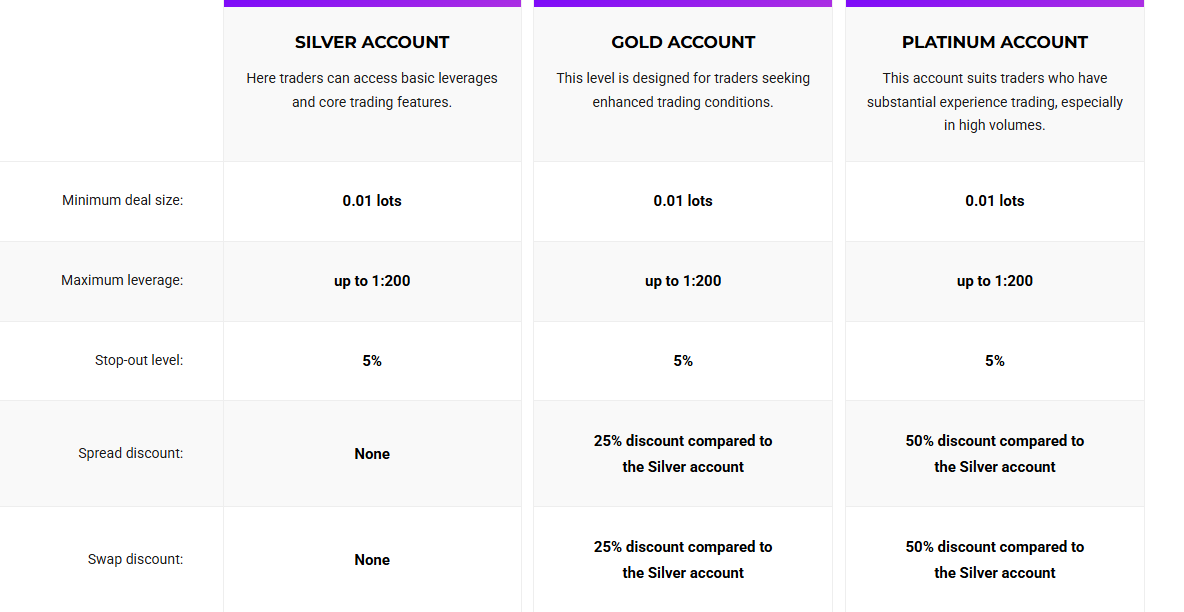
The differences between the accounts concern spreads and swaps. The Silver account uses the base rates, while spreads and swaps are reduced by 25% on Gold and by 50% on Platinum. This sounds appealing, but where can traders find the base values? If the broker’s employees had done their jobs properly, we could have found them on the Markets pages. Unfortunately, that was not the case, leaving us without the information needed to calculate trading costs and potential returns.
Fortunately, the document does contain most of the other parameters that genuinely matter to traders. These include:
- Minimum and maximum trade volumes.
- Swap rates for long and short positions.
- Trading hours.
- Margin requirements.
Even so, several questions remain. First, we paid particular attention to the margin requirements, which are listed separately for retail clients and professional traders. Our calculations show that leverage for retail clients is effectively capped at 1:30, while professionals can access leverage of up to 1:200.
This distinction makes perfect sense, as it is also used by regulators in jurisdictions such as the European Union. However, Airmarkets’ website says nothing about client categories or the conditions for obtaining professional status. Perhaps the broker does not want beginners to know the actual trading conditions? Or has the document been copied from a legitimate company operating under the supervision of a reputable regulator, with nobody bothering to edit the PDF file?
Now let us turn to another parameter that many beginners tend to overlook: the Stop Out level. At Airmarkets, it is set at 5%.
If a trader opens a position using their entire deposit — something beginners often do — a Stop Out trigger could leave them with a loss of 95% of their capital. The remaining 5% is unlikely to be enough to open another position. Even if it is sufficient, for example, with a large initial deposit, the remaining position size may be too small to recover losses across several trades. Given the level of risk encouraged by this broker, the remaining balance is more likely to be wiped out entirely than to generate enough profit to offset previous losses.
Experienced traders know that risk should be limited with Stop Loss orders and that they should never put their entire deposit at risk in a single trade. However, the overwhelming majority of beginners fail to follow these rules. It is hardly surprising, then, that under such conditions, clients’ money can disappear very quickly and end up in the broker’s hands. This is no coincidence: it helps explain why Airmarkets sets its Stop Out level so low while offering relatively high leverage.
Checking Compliance with Legitimate Rules
Of course, the broker is making a concerted effort to create the impression that it operates legally. On its website, it states almost proudly that it is operated by Airmarkets Comoros Ltd, a company registered on Mwali (Union of the Comoros). To make its claims more convincing, it even provides a full address and registration number, HV00726496. The website also lists license number BFX2026046, issued by the local financial regulator, MISA (Mwali International Services Authority). There is certainly enough official information here to verify the company’s claims.
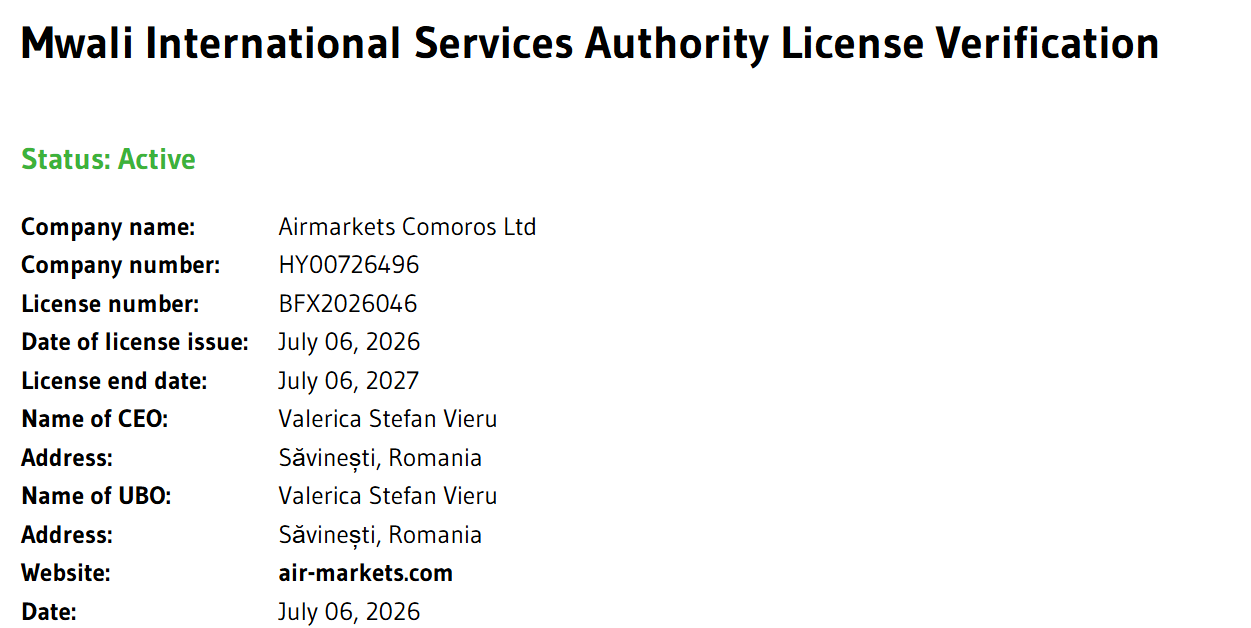
Naturally, we checked the records in MISA’s register and confirmed that the company does indeed exist. It owns the air-markets.com website and, consequently, the Airmarkets brokerage platform. It also holds a license bearing the stated number. However, there is one important detail: the company received this license on July 6, 2026, meaning that it has been authorized to provide services for only three months. Surely, that is far too short a track record for a platform seeking to earn the trust of the trading community.
How Long Has Airmarkets Been Around?
The broker’s official history is also of interest to us — and to traders in general. We have established that the company obtained its license approximately three months ago. To find out how long it has actually been operating online, we can turn to the information provided by the WHOIS service.
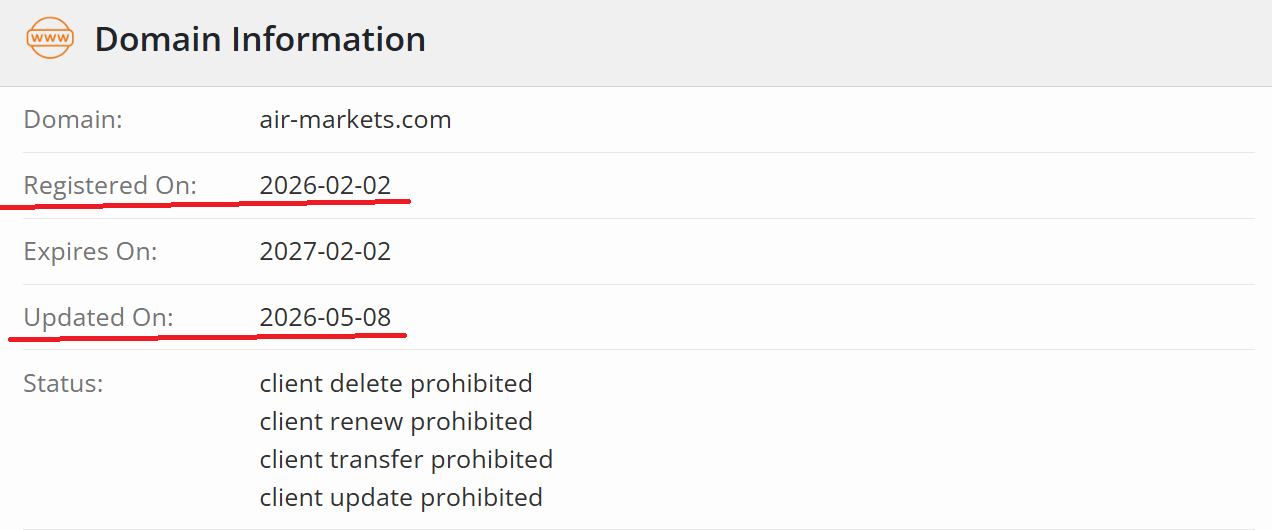
This further confirms our assessment of Airmarkets as a scam project. We are convinced that an honest broker would never provide services illegally, even at the very beginning of its operations, because such an approach could seriously damage its reputation in the long run. Scammers, on the other hand, do not concern themselves with such “minor details.”
Platform and Support Overview
We were eager to see the broker’s trading terminal and assess its web version and mobile applications. However, it turned out that the creators of the Airmarkets website had decided that not everyone should be allowed access to the Client Personal Area.
The problem is that we were unable to register on the broker’s website. Yes, the registration form opens without any issues, and filling it out is straightforward. However, once we attempt to submit it, strange things begin to happen. Potential clients receive a message stating that the company does not accept users from their country. Interestingly, this message appears to be shown to virtually everyone attempting to register independently, regardless of whether they live in or are accessing the website from a restricted jurisdiction. Even our employees using Indian and Brazilian IP addresses and telephone numbers were unable to create accounts. Yet, judging by the contact details, these appear to be among the main markets targeted by the platform.
This approach did not surprise us. We have encountered scam brokers that deliberately prevent users who find their websites independently from completing the registration process. Accounts are created without any problems only for those invited by company representatives during personal conversations. Here, too, potential clients are forced to contact customer support, whose staff then decide whether to grant them access.
Incidentally, the broker’s contact details are far from satisfactory as well. The Contact Us page provides:
- Telephone numbers with Indian and Brazilian country codes.
- A contact form.
- An invitation to contact support through the online chat available on the website.
The website also lists a registered address in the Union of the Comoros. However, it is a virtual address used by dozens of other brokers registered on the autonomous island of Mwali. The Privacy Policy also provides the support email address support@airmarkets.com, but the domain has reportedly been listed for sale for more than a year. It is worth adding that we were unable to get a response through the online chat either.
Overall, the picture regarding the available communication channels is rather poor. The complete absence of links to social media profiles does nothing to improve the impression. For a supposedly regulated broker, this looks rather strange, to say the least. Then again, we have already seen how Airmarkets treats its clients and witnessed the “professional” standards of its staff.
Online Reputation: What We Found
Interestingly, in just a few months of existence, the platform has already developed a rather mixed online reputation. For example, its ratings on industry portals such as WikiFX and FastBull differ dramatically. WikiFX’s scoring system gives the broker just 1.77 out of 10, and its experts have issued a warning to users about the lack of proper regulation, as the platform does not recognize the MISA license as legitimate. FastBull, on the other hand, has given Airmarkets a rating of 7.8 out of 10 based on user reviews. However, judging by the content of the posts, every air-markets.com review appears to have been commissioned.
As for platforms such as Trustpilot and Reviews.io, Airmarkets has yet to establish a presence there. However, articles and posts about the broker are beginning to appear on social media and informational websites. Interestingly, authors posting in groups and channels generally describe it as a scam project, while obscure online services enthusiastically praise it. Yet a closer look at these articles makes it immediately apparent that they, too, appear to have been commissioned and paid for by the platform’s management.
Conclusion: Risks and Reliability of Airmarkets
Thus, in our Airmarkets article, we have provided a detailed account of yet another broker registered in the Comoros and holding a MISA license. No properly licensed platform focused on genuine trading would conceal its trading conditions, even partially, attempt to mislead website visitors, prevent users from completing registration, or commission positive publications online. Since the platform we have examined does all of these things, we can draw an unequivocal conclusion: all its claims about high-quality service and excellent trading conditions are nothing more than an attempt to lure clients into yet another scam.
Sources
- Banque Centrale des Comores (BCC) press release
- MISA license verification
- Domain information by Whois



21.10.2026 at 21:53
This broker is a SCAM!
I opened an account with Airmarkets hoping for fair trading. When I was invited to join, their representatives spoke very convincingly about the company over the phone. However, after trying a couple of trades, I realized that the trading conditions were murky and the risks enormous. Unfortunately, by the time I understood what was going on, I had already lost €3000 out of my initial €6,000 deposit. But then the real nightmare began. When I tried to withdraw the remaining funds, my request was rejected without any explanation. There are no reliable ways to contact the company, the phone goes unanswered, and emailing them is completely pointless. What a great broker! It seems it was created solely to take people’s money and never return it!