

The broker’s administration publishes confident statements about opportunities and growth. Particular emphasis is placed on the availability of not only basic accounts but also a demo facility. We read claims of zero spreads, of more than 200,000 regular clients, and of widespread approval within the trading community. The company promotes optimized trading software and references artificial intelligence technology. Support for multiple payment methods is likewise highlighted. Well, when we look beyond the promotional language, a different picture emerges. In practice, the intermediary operates without proper regulation and is legally registered only offshore. The project demonstrates a modest level of trust and limited brand recognition. In this FGFC Markets review, we decide to examine whether the company bears the hallmarks of a fraudulent project.
Contents
- Key Points to Know
- What Stands Out About the Fgfcmarkets.com Website?
- Inside the Offshore Registration of FGFC Markets
- Trading Conditions Explained
- Checking Compliance with Legitimate Rules
- How Long Has FGFC Markets Really Been Around?
- Platform and Support Overview
- Online Reputation: What We Found
- Conclusion: Risks and Reliability
- Sources
Key Points to Know
| Main Website | https://fgfcmarkets.com/ |
| Additional Domains | https://client.fgfc.net/#/auth/login/ |
| Online Since | 16/11/2024 |
| Legal Entity Name | FGFC Markets LTD |
| Pretended to Be Regulated | Not Pretended |
| Fact-Checked Regulation | Not Found |
| Deposit to Start Trade | $500 |
| Leverage up To | Undisclosed |
| Spreads From | 0.1 pips |
What Stands Out About the Fgfcmarkets.com Website?
-
Links to the Client Agreement and other legal documents are available.
-
The project is not licensed by a recognized regulator.
-
FGFC Markets attracts negative feedback online.
-
The official website features a template-based, rudimentary interface.
-
The platform’s legal registration is offshore.
-
There is extensive reliance on manipulative CFD instruments.
Inside the Offshore Registration of FGFC Markets
The question of legal registration remains central, as the subject of our review operates within an offshore jurisdiction. On its official website, the firm states that it functions under the laws of Saint Lucia. A review of the relevant public register confirms that the entity is indeed incorporated there.
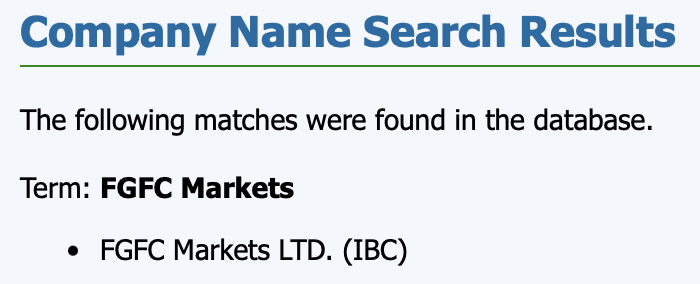
Moreover, offshore incorporation has tangible consequences for financial transactions. When clients transfer funds, payments are routed to accounts belonging to third-party entities in offshore zones. This complicates any potential recovery process and renders court action largely ineffective. We believe that this structural barrier alone significantly undermines the prospects of secure cooperation.
Trading Conditions Explained
FGFC Markets promotes several account types, including Standard, Raw, VIP, and Zero. The principal distinction between them concerns the minimum deposit requirement. We now turn to the financial instruments available, the leverage offered, the size of spreads and commissions, and the additional services advertised.
Clients are presented with access to crypto assets, metals, equities, indices and Forex markets. The total number of instruments is said to run into the thousands, though in practice the figure appears fluid, given the simplicity of the trading terminal employed. Notably, clients are strongly steered towards contracts for difference. It is worth recalling that CFDs carry a substantial risk of loss; industry statistics frequently indicate that over 80% of retail traders incur losses, a reality the broker’s administration prefers not to emphasize.
The minimum deposit stands at $500, while a premium account requires approximately $3,000. Both thresholds raise concern. Depositing such sums with an offshore entity lacking proper supervision introduces evident risk. Furthermore, transactions are predominantly conducted in cryptocurrency — another feature that invites scrutiny. We also find little clarity as to what concrete advantages justify higher deposits.
As for leverage, the company adopts an opaque stance. Account tables reference zero leverage, yet in practice, such parameters may be adjusted. Unscrupulous brokers often employ elevated leverage as a mechanism to accelerate client losses. We wonder whether similar practices could occur here.
The platform advertises educational materials, news services, a partnership program, and other supplementary features. However, many of these services appear inaccessible in practice. We assume that increasing one’s deposit in pursuit of promised “privileges” would be ill-advised.
Checking Compliance with Legitimate Rules
The legitimacy of FGFC Markets remains a matter of direct importance, as it fundamentally determines the safety and structure of any potential partnership. We will examine the regulatory dimension in greater depth. We will also consider the declared head office address and assess how realistic it would be to recover funds with professional legal assistance, should a dispute arise.
FGFC Markets holds no license from any recognized European supervisory authority, nor is there confirmation of supervision by a credible offshore regulator. Cooperation with an unlicensed intermediary invariably carries substantial risk. Among the most common consequences are account suspensions and refusals to process withdrawal requests. We have observed that companies operating outside formal oversight frequently resort to technical manipulations, particularly through browser-based platforms, which allow them to influence trading conditions to their advantage.

FGFC Markets website does reference a registered office address located offshore, specifically in Saint Lucia. However, a routine verification via mapping services suggests the absence of any tangible corporate presence. There is no evidence of a functioning headquarters. Moreover, the administration maintains strict anonymity regarding the company’s management. No information is provided about directors, executives, or key decision-makers. Such opacity is rarely associated with transparent financial institutions and, in our view, constitutes a significant warning sign.
How Long Has FGFC Markets Really Been Around?
The broker’s website provides no precise information regarding the date of the platform’s establishment. No historical timeline, no corporate milestones, and no verifiable record of development are offered. A WHOIS domain search indicates that the broker’s online presence dates back only to late 2024.
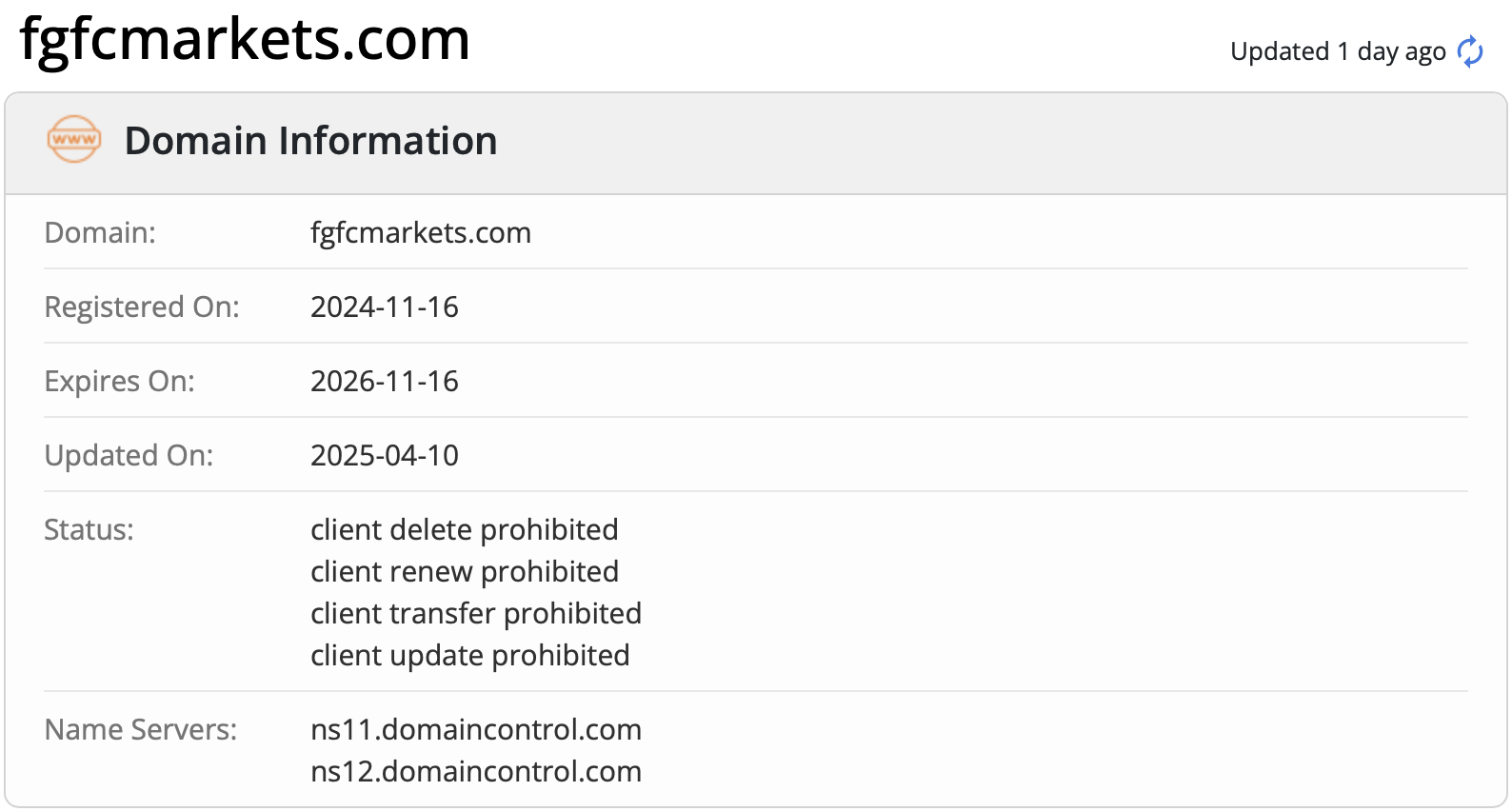
This relatively recent registration, when combined with minimal brand recognition and a scarcity of authentic client feedback, undermines any suggestion of an established market presence. We find no evidence of a sustained operational history that would justify claims of credibility or industry achievement.
Platform and Support Overview
FGFC Markets states that its trading platform is MetaTrader 5, a widely recognized terminal in the retail trading sector. The official website provides download links for various operating systems, reinforcing the impression of technological legitimacy.
However, the mere use of MetaTrader 5 does not in itself guarantee fair or secure trading conditions. We must recall that in cases involving questionable brokers, server-side control often rests entirely with the company. This technical authority enables management to influence spreads, commissions, execution speed, and even pricing data. Under such circumstances, the outcome for the trader may be structurally unfavorable. We consider that reliance on brand-name software alone should not be mistaken for proof of integrity.
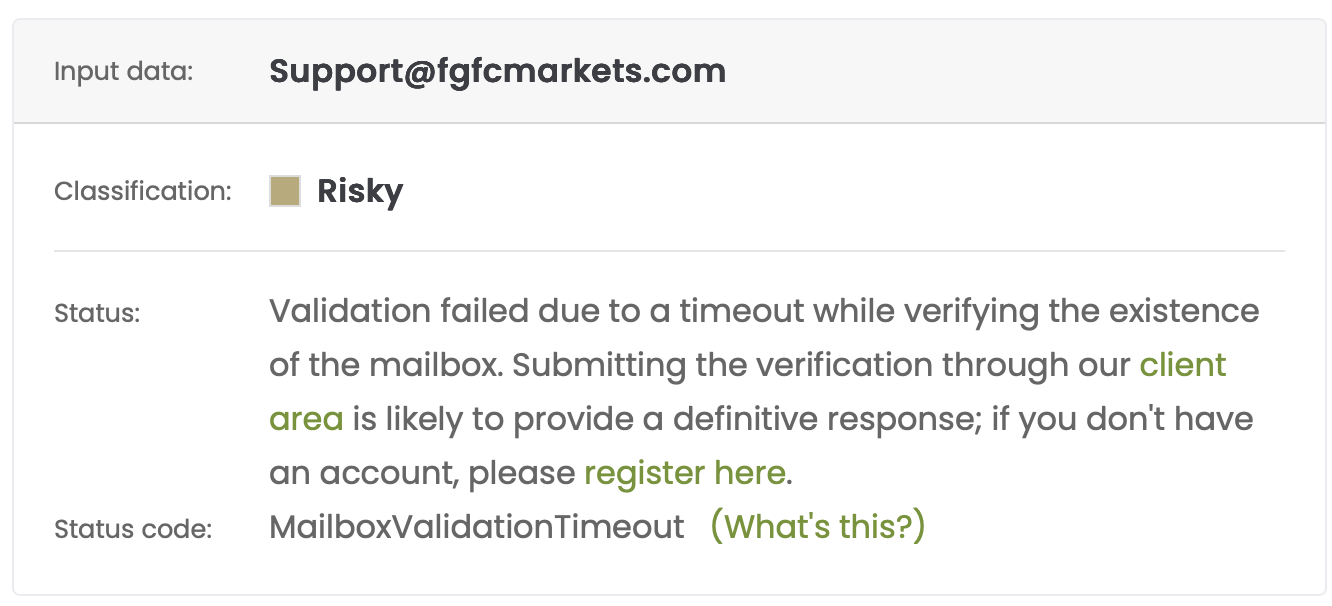
Customer support at FGFC Markets is conducted primarily via email, with a telephone number also mentioned. Nevertheless, there is little reason to expect consistent or high-quality service. An email validation check raises concerns about the reliability of the contact channel, suggesting that communication through this method may entail risks, including the potential misuse of personal data. The possibility of information leakage cannot be dismissed, particularly when dealing with an entity that already operates without transparent oversight.
Online Reputation: What We Found
FGFC Markets demonstrates minimal brand recognition. Although the website references social media pages, the links appear inactive. We wonder whether any meaningful audience engagement exists at all.
In summary, given the negative reputation and absence of transparent oversight, it is difficult to regard cooperation as safe.
Conclusion: Risks and Reliability
We advise against entering into a partnership with FGFC Markets. The company operates without a recognized license and maintains only offshore registration. Genuine client feedback is virtually non-existent, and brand recognition remains negligible.
Sources
- Domain verification via WHOIS.
- Verification of the stated head office address.
- Confirmation of legal registration.
- Email authenticity verification.



18.02.2026 at 14:33
Trading proved fruitless…
I lost $500 during my partnership with them. I tried to recover the funds through lawyers, but was told it was futile, as the broker is registered offshore…
21.03.2026 at 02:53
Empty project
I would not recommend even attempting to cooperate with such a company. They are a typical fraud, attracting client funds and then blocking accounts en masse.