

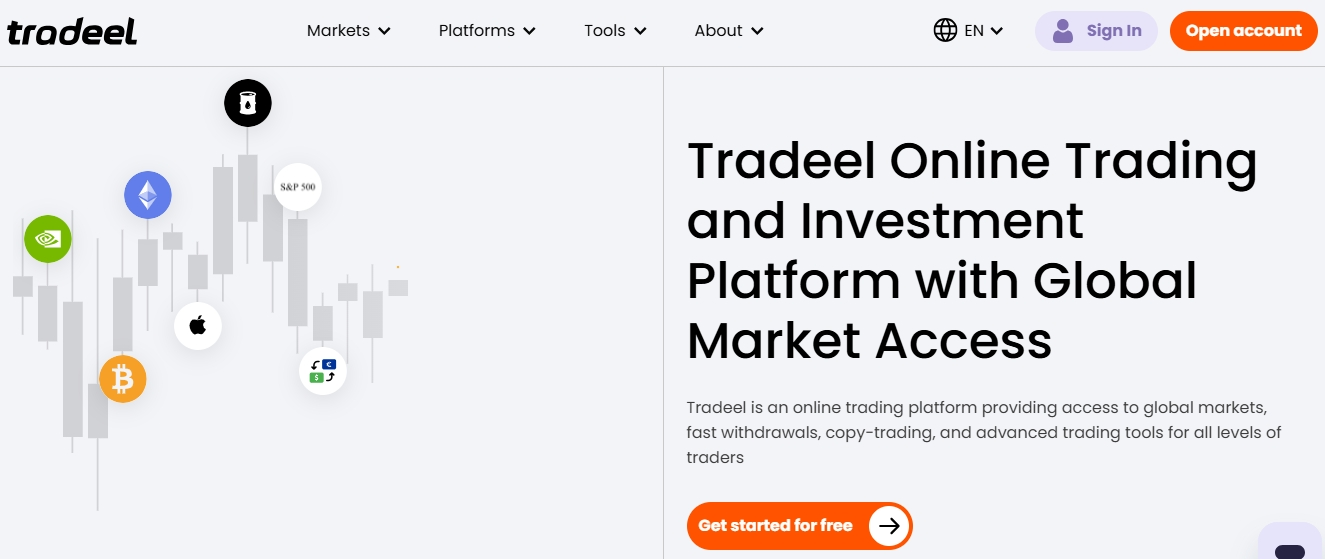
The company positions itself as a leading broker with years of experience and a brokerage license. However, we question their “impeccable reputation,” as an analysis of publicly available data and real user comments points to signs of a scam. In this Tradeel review, we’ll examine every detail and determine how safe it is for you to entrust your funds to this platform.
Contents
- Key Points to Know
- What Stands Out About the Tradeel.com Website?
- Inside the Offshore Registration of Tradeel
- Trading Conditions Explained
- Checking Compliance with Legitimate Rules
- How Long Has Tradeel Really Been Around?
- Platform and Support Overview
- Online Reputation: What We Found
- Conclusion: Risks and Reliability of Tradeel
- Sources
Key Points to Know
| Main Website | https://tradeel.com |
| Additional Domains | Not Found |
| Online Since | 2025-06-25 |
| Legal Entity Name | Tradeel LTD |
| Pretended to Be Regulated | MISA |
| Fact-Checked Regulation | MISA |
| Deposit to Start Trade | 100$ |
| Leverage up To | 1:1000 |
| Spreads From | Not Disclosed |
What Stands Out About the Tradeel.com Website?
-
6 markets for CFD trading.
-
Offshore registration.
-
Anonymous management.
-
No meaningful regulation.
-
Risks associated with crypto payments.
-
Non-transparent trading terms.
Inside the Offshore Registration of Tradeel
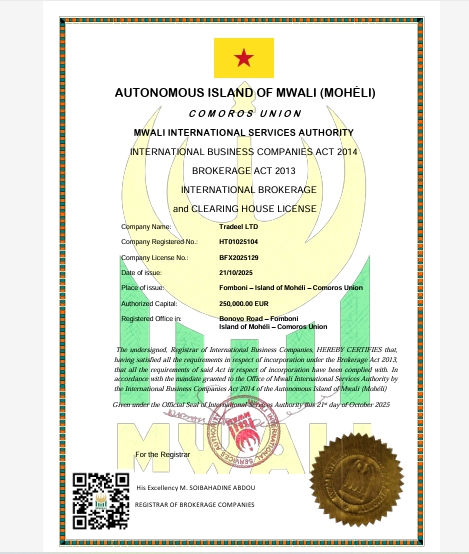
The intermediary claims to be registered in the Union of the Comoros (Mwali Island), using this as a cover for its activities. It should be noted that such offshore registration is merely a means of disguise and does not guarantee the legality of the company’s operations.
Furthermore, the license from Mwali is a questionable document, as the Central Bank of the Comoros does not recognize MISA’s authority to issue financial licenses. This “regulator” is a fictitious entity popular among unscrupulous brokers. The lack of real oversight by the authorities allows this brokerage firm to operate anonymously, without legal accountability or protection of traders’ interests.
Trading Conditions Explained
The owners of this platform decided not to complicate its structure and opted against dividing accounts into tiers, offering all users a single account type. They say nothing about minimum deposit requirements and mention only high-risk leverage of up to 1:1000. Meanwhile, in the FAQ section, managers state that the deposit amount depends on the chosen payment method. Each method, in turn, has a minimum deposit limit of $100. The broker also claims that over 4,000 assets are available for trading as CFDs across 6 markets, including commodities and ETFs.

Trading commissions are deliberately not disclosed on tradeel.com. The broker’s revenue is supposedly generated solely through the spread, the size of which the company does not guarantee. In reality, this means that with such a vast selection of instruments, the spread can be inflated to unbelievable levels at any moment, instantly closing your positions in the red. Such a lack of transparency in terms and conditions is a classic sign of a fake platform, where the rules of the game change on the fly in favor of the “boiler room.”
Checking Compliance with Legitimate Rules
The broker claims to be registered in the Union of the Comoros under number HT01025104 and provides a copy of the MISA license numbered BFX2025129, dated October 21, 2025. Checking this information on the MISA website confirms the authenticity of the license.
Furthermore, we received the following information:
- Google Maps. We did not find this broker’s office when we checked the address listed on the website using mapping services. In Fomboni (the capital of the island of Moheli), we saw mostly trees and single-story buildings with tin roofs. In other words, there are physically no skyscrapers or Class A business centers there, where brokers with “4,000+ assets” are typically located.
- Mass registration. This address appears in search results as the registered address for a dozen other identical clone brokers that have already been blacklisted by regulators. This is a clear sign that Tradeel is merely part of a production line for creating fake platforms.
- Absence of the broker in global databases. A search for this firm in the registries of reputable regulatory agencies yields zero results. This means that the activities of this intermediary are illegal in most countries.
Thus, an analysis of the project’s legitimacy shows that we are dealing with a typical example of an offshore fly-by-night firm, whose claims of reliability crumble at the first check of official registries.
How Long Has Tradeel Really Been Around?
The owners reveal nothing about their history and do not even disclose the launch date of this project. However, we determined that the platform has been operating for less than a year using the Whois service.
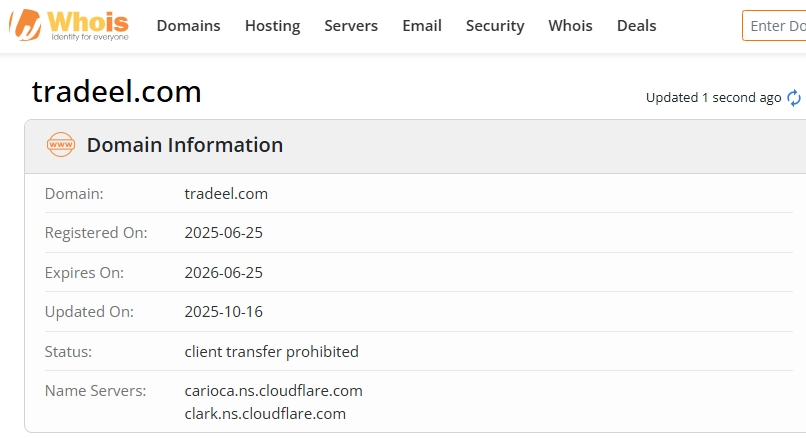
Despite the presence of an “About Us” section, the information presented there looks like a typical marketing fake designed to mislead. A detailed comparison of the statements with the technical data reveals a number of obvious inconsistencies.
First of all, the claim of “years of experience” doesn’t stand up to basic scrutiny. As we can see, the tradeel.com domain was only registered in June 2025, making any long history physically impossible. Furthermore, the website makes no mention of a rebranding or possible domain change, which could explain this.
Equally dubious is the claim of “more than 150 employees.” For a project with anonymous management and an offshore registration in the Comoros, this number seems unrealistic. Brokers of this scale typically have public employee profiles, LinkedIn pages, management information, and open positions — all of which are absent here.
Finally, the claims of “thousands of traders” are inconsistent with the timeframe. It’s impossible to build a large client base in the few months the domain has been in existence — from June 2025 to March 2026 — especially given the complete lack of mentions in reputable financial sources. Such figures are simply made up.
Platform and Support Overview
Instead of popular platforms like MetaTrader, Tradeel offers a nameless, proprietary WebTrader and mobile apps accessible only through the broker’s website. Please note that such software, often distributed as executable files without trusted digital signatures, gives the company full control over charts and quotes, which creates a high risk of manipulation and loss of funds.
The broker’s technical support is available via:
- Email contact@tradeel.support, which operates 24/7.
- Phone +44 7458 164441, which answers clients during business hours on weekdays. This is a virtual number (VoIP) that can be rented for a few dollars a month from anywhere in the world. The UK country code (+44) was specifically chosen to inspire trust in clients and create an appearance of reliability.
There is also an online chat. However, upon closer inspection, it turns out to be a typical marketing gimmick. Instead of connecting you instantly to an operator, the chat window functions like a standard feedback form: you’re asked to leave your name and email address, with a promise to respond “shortly.” This allows managers to filter messages and respond only to potential “donors” ready to make a deposit, while ignoring complaints from those trying to withdraw funds.
Online Reputation: What We Found
The broker’s online reputation appears highly suspicious: either there are no comments about the company at all, or the only tradeel.com reviews available online are a collection of paid, glowing testimonials. Crucially, a broker claiming to operate in four countries shows absolutely no real activity on social media — it has no verified Facebook pages and no genuine community on Telegram.
Meanwhile, Tradeel displays abnormally high ratings on non-specialized IT platforms such as Slashdot and SourceForge, indicating likely review manipulation. At the same time, an expert review on FXDailyInfo points to the company’s lack of a license and its offshore status, characterizing the broker as high-risk. In other words, Tradeel’s actual reputation is extremely low, and the positive ratings on IT websites are used to mislead traders.
Conclusion: Risks and Reliability of Tradeel
Our investigation reveales that Tradeel is a classic “boiler room” operation, where the company’s interests are directly opposed to the client’s success. Working with this platform carries critical risks, as half-hidden risky trading conditions and legality provided only by a weak, unrecognized regulator confirm that this project was created solely for the rapid collection of funds without any obligation to return them.
Sources
- Official statement from the Central Bank of the Comoros
- Verification of the registered address
- MISA license verification
- Domain information
- Email verification
- Lack of customer feedback on Trustpilot
- Tradeel has high ratings on Slashdot
- Similar positive reviews on SourceForge



17.02.2026 at 12:04
THIS IS THE ULTIMATE EXAMPLE OF DECEPTION AND FRAUD!!!
They lure customers with promises of limitless opportunities and high returns, but in reality, these are just empty words. Problems with withdrawals, delays in processing requests, and a lack of transparency – that’s what awaits gullible investors at https://tradeel.com/. On top of that, customer support either doesn’t respond or ignores inquiries. Finally, the lack of a UK license makes their operations illegal and dangerous. Friends, don’t let yourself be fooled – stay away from this scam.
27.02.2026 at 14:32
A bad experience
I did everything exactly as the consultants advised. However, I haven’t seen any profits. I’ve been following the copy trading strategy for a month now, and I check the settings every day. Meanwhile, I haven’t made a single cent yet. I should note that I’ve called the support line several times, left a message in the online chat, and sent emails, but they’ve chosen not to get in touch with me. TRADEEL staff only called me once, when I needed to open an account. They seemed to explain everything and were polite. Then they disappeared. Actually, I’ve already realized that my money was stolen. Of course, I still hold out hope, but I’m glad that I only spent €100 and didn’t invest a large sum right away. Although the managers persistently tried to convince me to invest €1,000. I’m writing this review to warn anyone who might be interested in this. I don’t recommend this platform, since I haven’t earned anything, even though a lot of time has passed. Of course, the choice is yours.
28.03.2026 at 14:45
I have no complaints
So far, everything seems to be going well. It looks like the company itself is new, but I haven’t had any issues with it. I’ve been working here for two months now, and everything’s fine so far 🙂 I have no particular complaints