

Today’s market is flooded with polished Forex/CFD brokers: they purchase inexpensive offshore licenses and, as a result, present themselves as legitimate companies. In every other respect, however, the picture is quite familiar: promises of the best possible trading conditions, elevated risks for traders, and commissioned reviews. In this FXRoad review, we will examine yet another project of this kind. Its creators try to attract clients with claims about a modern terminal, high-quality support, and transparent trading conditions. However, we believe this may be another product of scammers whose goal is to appropriate users’ money. Below, you will find our attempt to expose this scam platform.
Contents
- Key Points to Know
- What Stands Out About the Fxroad.com Website
- Inside the Offshore Registration of FXRoad
- Trading Conditions Explained
- Checking Compliance with Legitimate Rules
- How Long Has FXRoad Been Around?
- Platform and Support Overview
- Online Reputation: What We Found
- Conclusion: Risks and Reliability of FXRoad
- Sources
Key Points to Know
| Main Website | https://www.fxroad.com/ |
| Additional Domains | https://www.fxroad.co.in/ |
| Online Since | 2024 |
| Legal Entity Name | 4 Square SY Limited |
| Pretended to Be Regulated | Seychelles FSA |
| Fact-Checked Regulation | Seychelles FSA |
| Deposit to Start Trade | $250 |
| Leverage up To | 1:200 |
| Spreads From | 1.4 pts |
What Stands Out About the Fxroad.com Website
-
Registration in Seychelles and the existence of a license from the local regulator have been confirmed.
-
The entry threshold of $250 is accessible to almost any trader.
-
A license from the Seychelles FSA, issued by an offshore regulator, does not guarantee clients a high level of protection.
-
An offshore license significantly limits the list of countries whose residents the company is allowed to serve.
-
The firm does not provide full information about its trading conditions, leaving client risks high and actual costs impossible to assess.
-
The official website is poorly informative and lacks complete details about the company, markets, analytics, and educational materials.
-
There are quite a lot of reviews online, but a significant share of them are negative, while the positive ones appear to be ordered and paid for by the project’s administration.
Inside the Offshore Registration of FXRoad
The key requirements for a broker to operate legally are official registration and a license authorizing it to provide services in a particular country. On its website, the platform assures users that it has no problems in this regard.
FXRoad states that it operates under the control of 4 Square SY Limited, a company registered in Seychelles and acting on the basis of a license issued by the local regulator, the FSA. We checked the country’s business registry and received confirmation that the company is indeed registered.

However, this is hardly a reason for excessive optimism. Registration in Seychelles is one of the most popular solutions for international business, including Forex/CFD brokers. This jurisdiction strikes a balance between a classic offshore environment and modern transparency requirements. Legal entities there benefit from fairly lenient conditions:
- Territorial taxation principle. If income is earned outside the islands, it is fully exempt from corporate tax, capital gains tax, and dividend tax.
- Fast incorporation process. Registering a new company usually takes 24–48 hours.
- Minimal ownership and management requirements. A company only needs one director and one shareholder, and they may be the same person. They do not have to be residents of the country.
- Confidentiality. Information on directors, shareholders, and beneficial owners is held by the registrar and is not publicly available. However, it must be disclosed to the regulator upon official request.
So, registering a company in this jurisdiction is quite simple — all that is needed is an intermediary to handle the paperwork. The cost of the procedure is also relatively low:
- A basic package — including the state registration fee, the services of a registered agent, a legal address for the first year, and a standard set of incorporation documents in digital or printed form — usually costs between $600 and $900.
- A slightly more expensive package, costing around $1,100 to $1,400, includes the same services with an apostille, which may be required when opening company bank accounts locally.
Registration must be renewed annually. The renewal procedure includes payment of the state fee (a fixed amount equivalent to $150), a bookkeeping records storage fee (the requirement to retain accounting documentation for 7 years came into force in 2026), as well as agent services and office rental fees, with even a virtual office being acceptable. For owners who manage everything remotely, the total annual cost usually ranges from $600 to $1,200.
Yes, a license from the Seychelles FSA is not considered one of the most prestigious regulatory authorizations, although many market participants still regard this regulator as reasonably credible. A commonly cited point in its favor is that many Forex/CFD brokers ranked among the industry’s top twenty operate under its supervision.
Even so, a Seychelles FSA license remains an offshore authorization and is unlikely to satisfy traders who prioritize the safety of their funds. The main reason is that the FSA:
- Does not impose capital requirements on brokers at the level applied by top-tier regulators. Under the Securities Act, as amended in 2024 and currently in force, a Securities Dealer must maintain own capital equivalent to $100,000. This amount appears rather modest, especially compared with the corresponding requirements of the UK’s FCA (around $730,000) or Australia’s ASIC (AUD 1,000,000+).
- Does not operate its own Investor Compensation Scheme and does not require brokers to participate in third-party compensation funds or to insure client deposits or the company’s liability. In practice, this means that the platform’s clients have very limited chances of recovering their money in the event of the firm’s bankruptcy or other force majeure circumstances.
- Does not require companies to place client funds in segregated accounts.
- Does not impose meaningful restrictions on key trading conditions, such as maximum leverage.
This means that a license from the FSA of Seychelles does not in itself guarantee that its holder is not a scam operator. In practice, it only confirms that the firm complies with local laws, which, as we can see, are not particularly strict when it comes to brokers. At the same time, traders do not receive any strong protection of their rights and interests, although they may still file complaints with the regulator. We have mentioned top brokers that operate under an FSA license, but there are also plenty of opposite examples where this authorization is used by questionable or outright fraudulent projects.
Trading Conditions Explained
It should also be noted that the FSA of Seychelles applies softer standards for the disclosure of trading information than the most reputable regulators. Brokers make active use of this flexibility, and FXRoad is no exception. We began reviewing the trading conditions with the information provided on the account description pages.

In fact, the table with account types contains very little detail. From it, we can only learn that:
- The broker offers traders four account types: Silver, Gold, Platinum, and Islamic (swap-free).
- The maximum leverage for all of them is 1:200.
- There are no fees for funding the account.
The same section also indicates the starting spreads, but more details can only be found on separate pages where somewhat fuller information is provided.
As it turns out, the maximum leverage applies only to Forex pairs. For other asset classes, the leverage is lower:
- 1:50 for CFDs on indices, metals, and other commodities.
- 1:10 for CFDs on stocks and ETFs.
- 1:5 for CFDs on cryptocurrencies.
These pages also contain a table showing the spreads for major trading instruments. The benchmark value — the spread on the EUR/USD pair — is 2.6 pips on the Silver account, 2.0 pips on Gold, and 1.4 pips on Platinum. Even with the discounts offered on Gold and Platinum, this hardly looks encouraging for traders. In practice, this means trading costs based on spreads alone are two to four times higher than those charged by most regulated brokers.
For those who want to know even more about the trading conditions, FXRoad has prepared a document with the telling title Contract Specifications. The problem is that it is not easy to find. It is posted on the Legals page, the link to which is available only in the footer menu. Why the broker chose not to place such important information in the main navigation menu remains unclear.
In fact, the document contains full trading specifications for all instruments. It lists the margin requirements (which make it easy to calculate leverage), the swap rates for long and short positions, contract size, tick value, minimum and maximum position volume, and trading hours.
However, even here, the information turned out to be incomplete. For example, the broker does not specify the Margin Call / Stop Out levels, the allowed distance for placing pending orders, or the minimum and average spreads, among other things.
In short, FXRoad has disclosed its trading conditions in fairly broad detail. However, for traders this is hardly a gift — rather, it is a disappointment. First, the trading risks are excessively high, and it is impossible to assess them fully without information on order placement rules and automatic position closures. Second, trading costs are multiple times higher than those of most regulated brokers. Third, some of the characteristics published on the website appear unreliable. This creates the impression that the platform’s staff are ready to do everything possible to absorb the client’s entire deposit. Of course, the owners have protected themselves legally, and all trader losses may appear formally legitimate. But, as you understand, that does not make things easier for users, nor does it make the broker’s practices any more honest.
Checking Compliance with Legitimate Rules
We have already mentioned that the broker’s registration in Seychelles has been confirmed. The remaining question is whether it actually holds the required license.
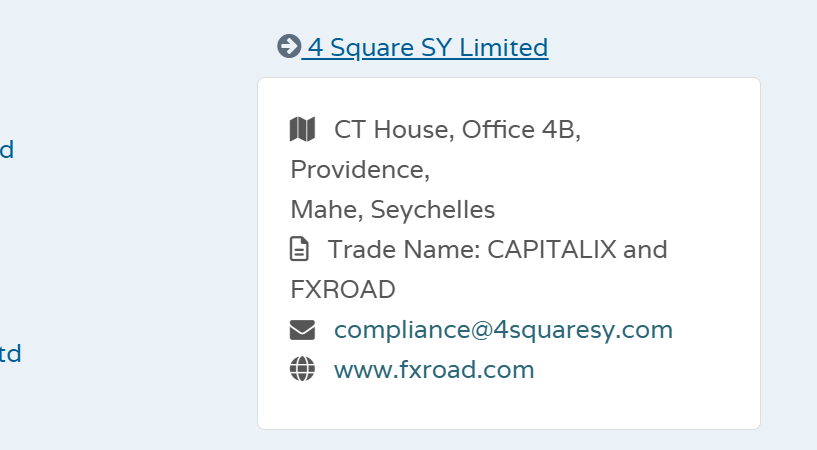
In the list of regulated legal entities published by the FSA of Seychelles, we found an entry for 4 Square SY Limited, which holds a Securities Dealer license. The same record also includes the company’s trading names, among them FXRoad and the official website FXRoad.com. Therefore, the information published by the broker is fully confirmed, and there is no real doubt that it does hold a license from the Seychelles regulator.
It is also worth noting that the Legals page on the official website even contains a scanned copy of the certificate confirming the registration of the business name FXROAD by 4 Square SY Limited, issued by the registrar on June 16, 2023. In other words, there is little doubt that the company is formally providing brokerage services in accordance with Seychelles law.
The problem is that, in order to operate legally in both India and Brazil, brokers are required to hold licenses from the relevant local regulators: SEBI (Securities and Exchange Board of India), RBI (Reserve Bank of India), and CVM (Comissão de Valores Mobiliários).
Brazilian traders are not prohibited from working with foreign brokers. However, if the company does not hold a local license, the provision of services is still considered unlawful. In the event that profits are withdrawn, local banks may block the transaction until the trader provides proof of the lawful origin of the funds and confirms that the required taxes have been paid.
In India, the situation is even more complicated. The Foreign Exchange Management Act limits the activities of Forex brokers: they may offer only currency pairs involving the rupee and may conduct trading only on official exchange venues. The over-the-counter market — and retail Forex belongs precisely to this category — is completely prohibited. Using the services of brokers that do not comply with these rules may expose traders themselves to liability for violating foreign exchange regulations.

As we can see, traders targeted by FXRoad are more likely to face problems with official authorities in their own countries than to make a profit. The question is whether it makes sense to take such risks when dealing with a company that effectively puts its clients in a vulnerable position.
How Long Has FXRoad Been Around?
Traders generally believe that the date of a company’s creation and the launch of a broker’s operations should be clearly disclosed, but this information is missing from the official website. To clarify the matter, we turned to open sources.
First of all, it is worth recalling that the firm registered the business name FXRoad in June 2023. Next, we examined data from the Whois service.
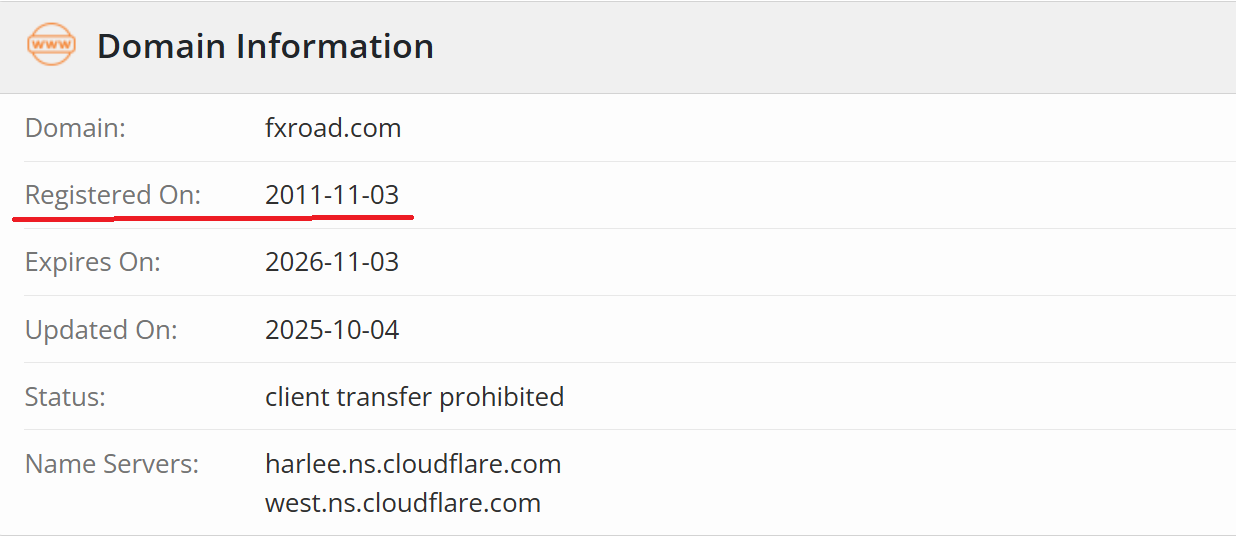
As we can see, the domain itself has existed for quite a long time — since November 2011. However, snapshots from the Web Archive confirm that the site began operating in its current form much later. Even in March 2024, the website displayed the message “Our Website is Coming Soon”, and only in May do we see the first full snapshot of the platform. At the same time, the first fxroad.com review was dated April 21, 2024. Accordingly, we can confidently say that the project has been active online only since April–May 2024.
Platform and Support Overview
FXRoad modestly describes its trading terminal as “an excellent solution” and claims that it ensures a comfortable experience for any user. However, it turned out that traders are not being offered an original in-house development, but rather software used by many brokers holding offshore licenses — as well as by outright scam operations. Once again, we see an attempt to mislead potential clients, although the practical sense of such a move is questionable.
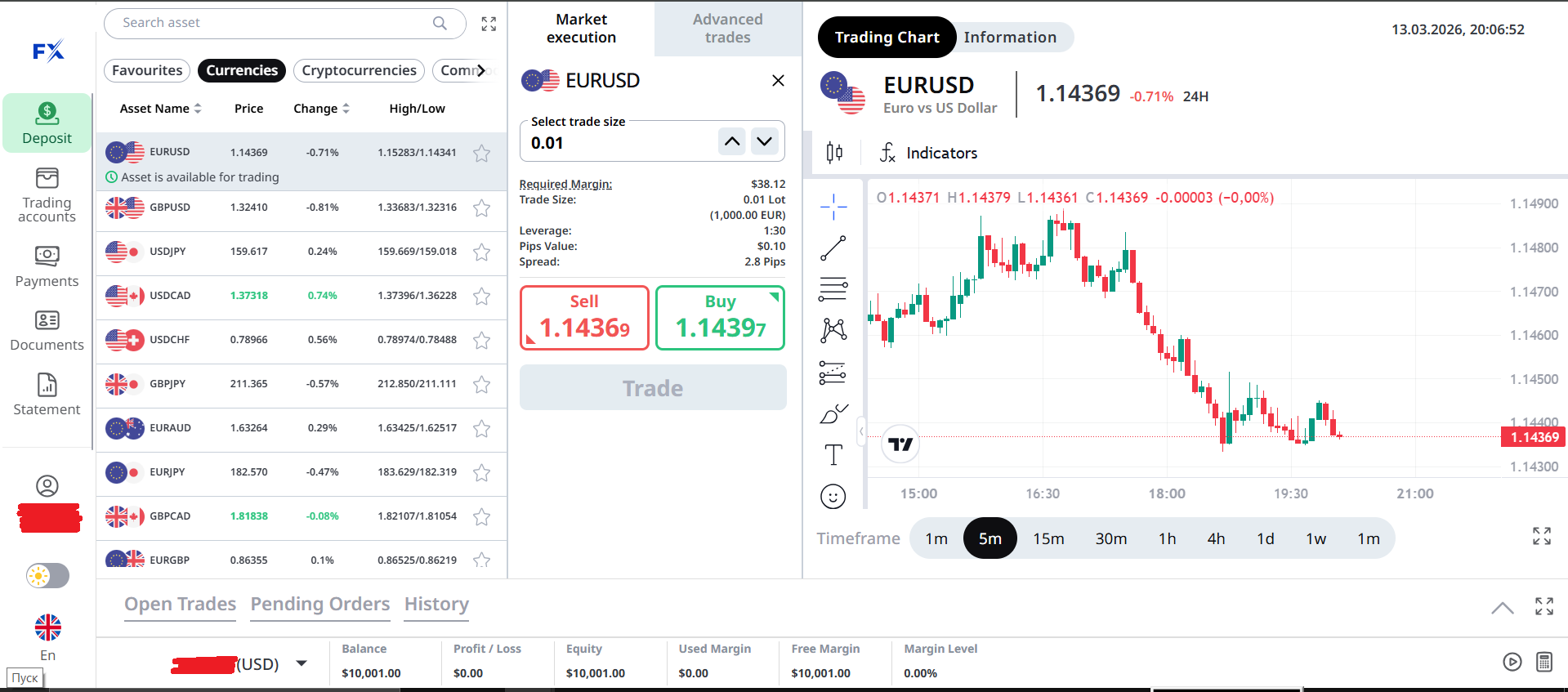
The platform is built around TradingView’s price-chart widget. As a result, it offers an excellent set of technical indicators and drawing tools for market analysis. This allows users to build trading systems of almost any complexity. Unfortunately, the developers never solved the issue of adding custom or third-party indicators, nor did they provide support for connecting automated trading scripts, even at the API level. So in practice, traders are limited to manual trading only.
Another strong point of the terminal is its interface. It is intuitive and fairly easy to learn. However, it also has a drawback: the layout of all panels is fixed from the start, and the only thing users can really customize is the size of the windows.
The software has several other weaknesses as well:
- It is possible to display several price charts in one window, but only through the standard comparison/add-symbol tool. It would be difficult to call this a multi-chart mode.
- It is not possible to trade directly from the chart or use a 1-click trading mode, since such functions are not provided.
- The built-in market overview widget is not particularly convenient and requires extra time to select the main chart for a chosen instrument. This delay is not critical in calm market conditions, but it makes life harder for scalpers and during periods of high volatility.
To let users contact broker representatives, the Contact Us page provides:
- A feedback form.
- A support email address.
- Phone numbers with Brazilian and Indian country codes.
- The registration address and, according to the website developers, the head office address in Seychelles.
In addition, users can access an online chat on all pages. The footer also contains links to the company’s social media pages.
At first glance, this all looks fairly solid. However, the same address, down to the office number, is used by dozens of companies registered in Seychelles.

There is little doubt that this is a virtual address provided by the agent who handled the company registration. Accordingly, FXRoad does not appear to have any real physical office. The phone numbers also look quite telling. First, they confirm the broker’s very limited geographic focus. In reality, it seems to target just two countries — India and Brazil — as we have already noted. Second, the phone numbers belong to VoIP pools, which further supports the conclusion that the company exists almost entirely in virtual form.
Online Reputation: What We Found
Trying to find public opinion about FXRoad online revealed quite a few surprising facts. To begin with, there are remarkably few reviews for a company that has supposedly been operating online for about 22 months. Our search found only 17 comments on FXVerify, with an average rating of 2.1. For a real broker, that is not much at all.
At the same time, no publications about the broker could be found through Trustpilot’s regular search tools. However, a Web Archive snapshot shows that as of May 12, 2025, the page contained 632 reviews, 30% of them negative, while the positive ones appeared to be purchased. Today, that page is still accessible through its direct address, but no more than about 300 comments remain. The portal does not display it in search results and has placed a notice in the header saying that accepting new reviews for FXRoad has been temporarily suspended. We do not know what caused this page to effectively disappear from public search, and the platform administration states that it is prepared to answer this question only to the page owners.
Conclusion: Risks and Reliability of FXRoad
All that remains is to sum up the findings presented in this FXRoad review. The company operates under a license issued by the FSA of Seychelles. However, such authorization does not guarantee that a broker acts honestly or that client rights are properly protected. At the same time, the official website contains plenty of inaccurate information, the trading conditions can hardly be described as favorable or safe, and the listed contact details suggest that the firm exists only online. In addition, the project owners appear to have tried to manufacture its reputation artificially by ordering reviews and promotional publications online. Yet the opinions of both users and industry experts suggest that its methods are much closer to those of scammers.
Sources
- Seychelles Securities Act
- Indian Foreign Exchange Management Act
- RBI alert list
- Domain information by whois
- Web archive site history
- Web archive snapshot of Trustpilot page



09.02.2026 at 23:18
FXRoad are scammers!
They stole my two thousand dollars!! They blocked access to my account and refuse to let me withdraw the funds. They answer calls only occasionally, keep redirecting me to different specialists, and every single time I have to explain the whole situation from the beginning. Nobody can tell me why my account has been blocked. I would not even recommend speaking to these scammers!
15.02.2026 at 19:32
trading performance staged like a show
These fraudsters worked on me for a long time before convincing me to invest money. I hoped they would honor their promises and honestly route trades to the real market, but no. The scammers were merely putting on a cheap performance of trading, while in reality they did everything possible to take my money. Their platform “helped” me lose $1,500 in just four days. Do not trust FXRoad — it is a typical SCAM!